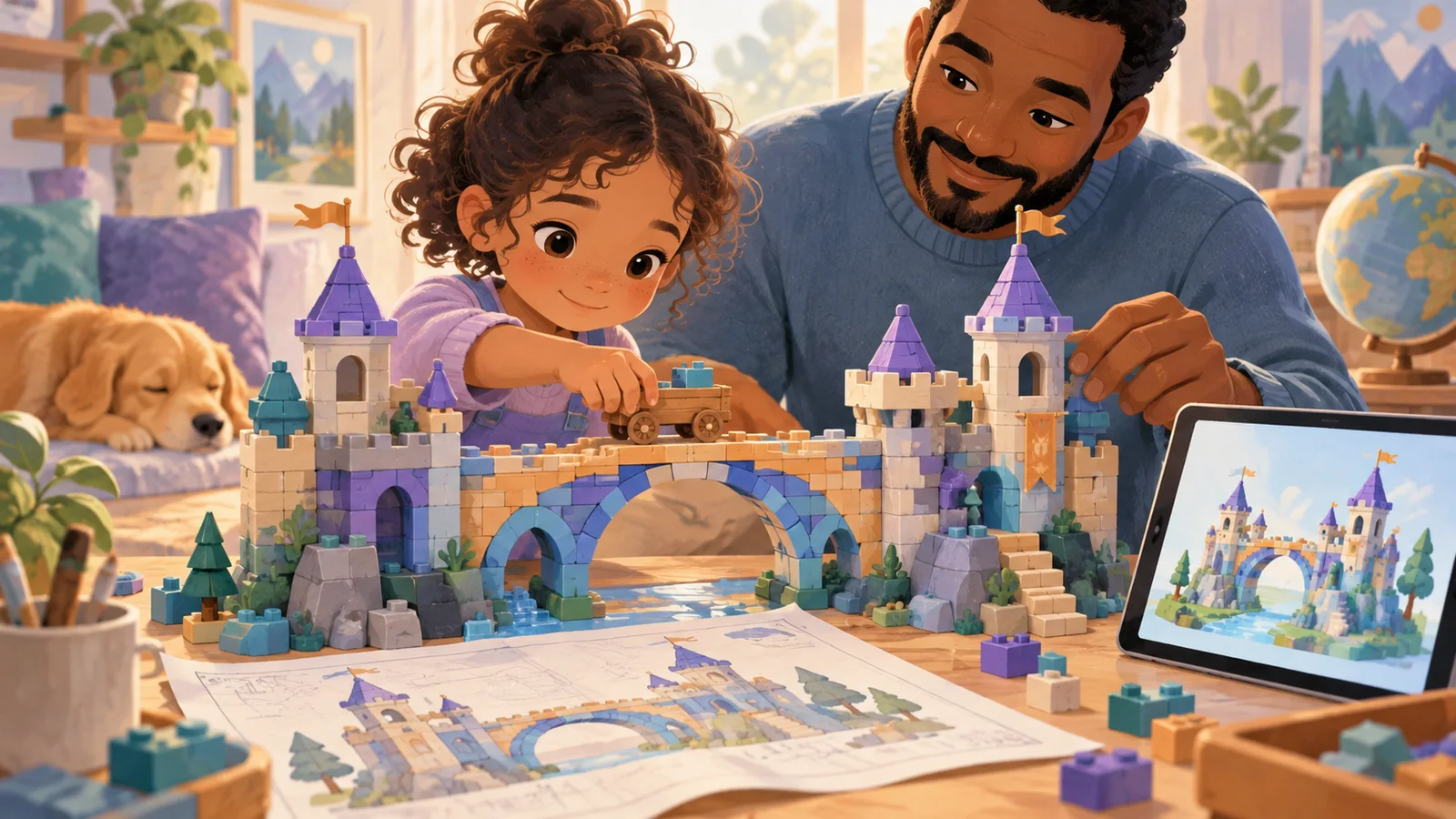
Why 3D Building Games Predict Math Success: The Spatial Reasoning Research
Version 2.10 — Updated October 2026
When parents ask me whether 3D building games are "educational," I usually answer with a question back: what do you mean by educational? If educational means "teaches multiplication tables" or "drills
When parents ask me whether 3D building games are "educational," I usually answer with a question back: what do you mean by educational? If educational means "teaches multiplication tables" or "drills vocabulary," then no — building games don't do that, and they shouldn't pretend to. But if educational means "develops the cognitive skill that most reliably predicts whether a kid will thrive in math, science, and engineering ten years from now," then the answer is an emphatic yes, with decades of research behind it. The skill is called spatial reasoning, and it's been sitting quietly in the developmental psychology literature for 50 years while most parents have never heard the term.
This article explains what spatial reasoning actually is, why it matters more than most early-childhood measures, and — most importantly — how 3D building games (digital or physical) develop it in ways that flashcards and worksheets can't. By the end, you'll understand why PBS Parents calls spatial skills "the secret ingredient" to STEM success, and why investing in building play at age 5-8 pays off in middle school math in a way that almost nothing else does.
What Spatial Reasoning Actually Is
Spatial reasoning is the ability to visualize how shapes and objects move, fit, and relate to each other in space. It sounds abstract, so let me make it concrete with a few everyday examples:
- Packing a suitcase efficiently. That's spatial reasoning.
- Looking at a flat-pack furniture diagram and predicting what the finished piece will look like. Spatial reasoning.
- Reading a subway map and choosing the right transfer. Spatial reasoning.
- Mentally rotating a Tetris piece to see if it'll fit. Spatial reasoning.
- Building a LEGO model from a picture with no instructions. Spatial reasoning.
Psychologists usually break it into four sub-skills: mental rotation (picturing an object turned), spatial visualization (picturing parts fitting together), spatial orientation (knowing where you are relative to landmarks), and spatial relations (how objects position compared to each other). All four are separable, all four are trainable, and all four are predictive of later STEM outcomes — but the predictive power is strongest when they develop early, before age 10.
The Research That Surprised Everyone
The breakthrough came from a 2013 meta-analysis by David Uttal at Northwestern University, which pulled together 217 studies on spatial skill training. The finding was clear and surprising: spatial reasoning is not fixed. It's highly trainable, and training effects persist. A kid who gets 20-40 hours of focused spatial practice performs measurably better on spatial tasks months later — and, more importantly, their math and science achievement improves alongside.
Subsequent research has tightened the link. A study published in Frontiers in Education (2024) showed that spatial reasoning scores at age 5-7 predict math achievement at age 11 better than early math scores themselves. Let that sink in. If you want to predict whether a 5-year-old will be good at math in fifth grade, testing them on spatial puzzles is more accurate than testing them on counting.
PBS Parents summarized it like this: "Spatial reasoning is one of the strongest predictors of later success in math, science, engineering, and even reading. And the earlier it develops, the better the foundation for future STEM learning."
Why is spatial reasoning so predictive? Because math and science aren't really about calculation — they're about representing problems in your head and manipulating those representations. A kid who can mentally rotate a cube can mentally rotate an algebraic expression. A kid who can mentally fit puzzle pieces together can mentally fit scientific concepts together. The underlying cognitive machinery is shared, even when the content looks different.
The Spatial Skills Gap (and Who Has It)
Here's the uncomfortable part. Research consistently finds that the spatial reasoning gap between children is large, visible by age 3, and correlated with experiences more than talent. Specifically:
- Kids who spend time building (blocks, LEGO, puzzles, construction toys, 3D games) develop spatial skills significantly faster than kids who don't.
- The gap compounds over time, because kids who are already good at spatial tasks tend to seek out more building-type activities, while kids who feel "bad at it" avoid them.
- Parents and teachers rarely talk about spatial skills directly, so they don't get the same attention as reading or counting — even though they're equally predictive of later outcomes.
The good news is that the gap closes quickly with deliberate practice. The studies on spatial training are unusually optimistic about trainability. Unlike some cognitive abilities that are hard to shift, spatial skills respond strongly to a few hours a week of focused building play.
How Different Activities Stack Up for Spatial Development
Not all building activities are equal. Research on the specificity of spatial training suggests some activities develop the skill more efficiently than others.
| Activity | Mental Rotation | Spatial Visualization | Orientation | Time Per Session |
|---|---|---|---|---|
| Physical LEGO from instructions | Medium | High | Low | 20-60 min |
| Physical LEGO free build | Medium | High | Low | 20-90 min |
| Magna-Tiles | High | High | Low | 15-45 min |
| Jigsaw puzzles | High | Medium | Low | 10-30 min |
| Tetris | High | Medium | Low | 5-15 min |
| Minecraft (Creative mode) | High | High | High | 30+ min |
| 3D building games with ghost targets (like Blocky's) | High | High | Low | 3-10 min |
| Worksheet "circle the matching shape" | Low | Low | Low | 5-10 min |
| Watching building videos (YouTube) | Low | Low | None | Variable |
A few observations from this table worth calling out:
- Passive watching doesn't count. Watching a Minecraft YouTuber build things doesn't develop spatial reasoning. It develops video-watching skills. Your kid has to be the one deciding where the block goes.
- Short sessions still count. A common worry is that a 3-minute building session is "too short to matter." The research doesn't support this. Spatial learning appears to consolidate across sessions; five 3-minute sessions a day may be as effective as one 15-minute session, and easier to fit into a young kid's attention span.
- Ghost-target games and guided building are efficient. A game that shows a target shape and asks the child to fill it in is essentially spatial reasoning practice in purest form. Every placement decision requires comparing the current state to the target and mentally rotating the needed block.
- Free building develops different sub-skills than guided building. Both matter. Kids who only do guided builds get good at following; kids who only free-build get good at imagining but sometimes weaker at precision. The ideal mix is both.
What This Means for Screen Time Conversations
Parents often frame screen time as a binary: screens are bad, screen-free is good. The research on spatial learning complicates that picture in ways that are useful. A child who spends 20 minutes on a 3D building game with structured spatial challenges is getting measurable spatial reasoning practice. A child who spends 20 minutes watching cartoons is not. Both are "screen time," but they have opposite effects on spatial development.
This is the core insight MIT Media Lab's Mitchel Resnick has been arguing for years: screen time quality matters more than screen time quantity. His essay "Screen Time? How about Creativity Time?" is worth reading in full. The short version: rather than trying to minimize screens, parents should be trying to maximize creative, constructive uses of screens and minimize passive, consumptive ones.
Translated into practice: a browser-based building game where your kid is actively placing blocks to match a target is not the same category as YouTube Kids, and shouldn't count the same way in your household's screen time budget. If you're treating all pixels as equal, you're missing the most important lever.
For the practical activity side of this research — specific spatial-skill exercises for 5-7 year olds — see my companion piece on the spatial skills gap and what every 5-7 year old should be practicing. For the physical vs digital building question specifically, see physical LEGO vs digital 3D building: which one actually teaches more?.
The Vocabulary Parents Should Use Out Loud
One finding that's consistently surprised me in the spatial development literature: the words parents use during play matter. Simply narrating the building — "you're rotating it to fit," "that side is perpendicular to the bottom," "can you see how these two pieces mirror each other?" — measurably accelerates spatial skill development. Researchers call this "spatial language input," and studies show that kids whose parents use more spatial language develop stronger spatial skills even controlling for play time.
Specific words to use more often while your kid is building:
- Rotate, flip, turn, tilt
- Above, below, next to, between, around, through
- Symmetric, mirror, opposite, parallel, perpendicular
- Taller, wider, deeper, shallower
- Angle, corner, edge, face, surface
- Balance, lean, support, base
You don't need to turn building into a lecture. Just sprinkle these words in. "I see you're turning it — where's it going to go?" is already more spatial-language-rich than "cool, keep building." Over a few weeks, this adds up.
How to Structure 3D Building as Daily Spatial Practice
If you want to treat 3D building like the spatial reasoning workout it actually is, here's the parent version of a routine that works for kids age 5-10:
- 10-15 minutes a day, most days. Frequency matters more than length.
- Mix guided and free building. Two out of three sessions can be guided (following a target or a set); one session a week should be completely free.
- Use spatial language while they build. Rotate, flip, between, parallel, symmetric. A few words per session.
- Ask "what if" questions. "What if you turned it sideways?" "What if you started from the top?" These questions push them toward mental rotation practice.
- Celebrate the finished build. This isn't just feel-good — the reward loop increases the child's willingness to come back tomorrow, which is what makes the practice consistent enough to matter.
Most families find step 1 (the consistency) is the hardest. This is where the convenience of a free, no-setup, browser-based 3D builder starts to matter more than any specific feature. A tool you can open in 10 seconds gets used daily. A tool that needs setup, downloads, or sign-ins gets used weekly.
The Practical Upshot
If your kid is 4-10 and you care about math, science, or engineering outcomes down the line, the single highest-ROI thing you can do is build more 3D structures with them — physical or digital, solo or together, structured or free. The research is unusually clear on this, and the effect sizes are larger than most early-childhood interventions.
The tools don't need to be expensive or fancy. A cheap Magna-Tiles starter set works. A box of LEGO Classic works. A free browser-based 3D building game works. What matters is time-on-task with real decisions about how shapes fit together — plus a parent who sometimes says "rotate" and "symmetric" out loud.
Build a Daily Habit — Free
Blocky's 3D Block Adventure is designed for this exact spatial-reasoning use case: short, daily sessions with ghost-target scaffolding and free-build modes. Structurally, it matches everything the research says works:
- 3-10 minute sessions — short enough for daily repetition
- Ghost-wireframe targets that force mental rotation and visualization practice
- Auto-snapping placement removes motor-control frustration so cognitive load stays on spatial thinking
- 15 graded levels that scale with skill, so the practice stays at the edge of ability
- Free forever, works in any browser, no signup — removes the friction that kills daily habits
Start your kid's spatial reasoning workout: kidsaitools.com/en/blocks
Sources: PBS Parents: Spatial Skills and STEM Success, Edutopia: How to Foster Spatial Skills, Frontiers in Education: Projective Geometry and Spatial Reasoning for STEM, and MIT Media Lab: Screen Time? How about Creativity Time?.
Ready to try this with your child?
Knowing which AI tool helps for homework is one thing — getting your child to actually use it productively is another. These four products are how we bridge that gap at home.
| Your child's goal | Try this | Why it works |
|---|---|---|
| Build 3D creations hands-on | 🧱 3D Block Adventure | Browser-based 3D building: 15 levels plus AI Magic Build. Ages 4-12, no downloads. |
| Play an AI game right now | 🎨 Wendy Guess My Drawing | Draw for 20 seconds and the AI tries to guess. Ages 5-12, zero setup. |
| Create art or stories | 🎨 AI Creative Studio | Built-in safety filters. No sign-up needed for 10 stories and 2 AI pictures a day. |
| Pick the right AI tool for your child | 🛠️ 50+ Kid-Safe AI Tools | Filter by age, price and safety rating. |
All four start free, run in the browser, and never ask for a credit card up front.
For you, the parent: NotebookLM for Families: Turn Any Textbook Into a Podcast goes deeper on this — a step-by-step guide in the KidsAiTools Parent Library.
📋 Editorial Statement
Written by the KidsAiTools Editorial Team and reviewed by Felix. Our guides are written from a parent-builder perspective and focus on AI literacy, age fit, pricing transparency, and practical family use. We do not currently claim named external expert review or a child-test panel. We may earn commissions through referral links, which does not influence our reviews.
If you find any errors, please contact support@kidsaitools.com. We will verify and correct as soon as we can.
Last verified: October 9, 2026