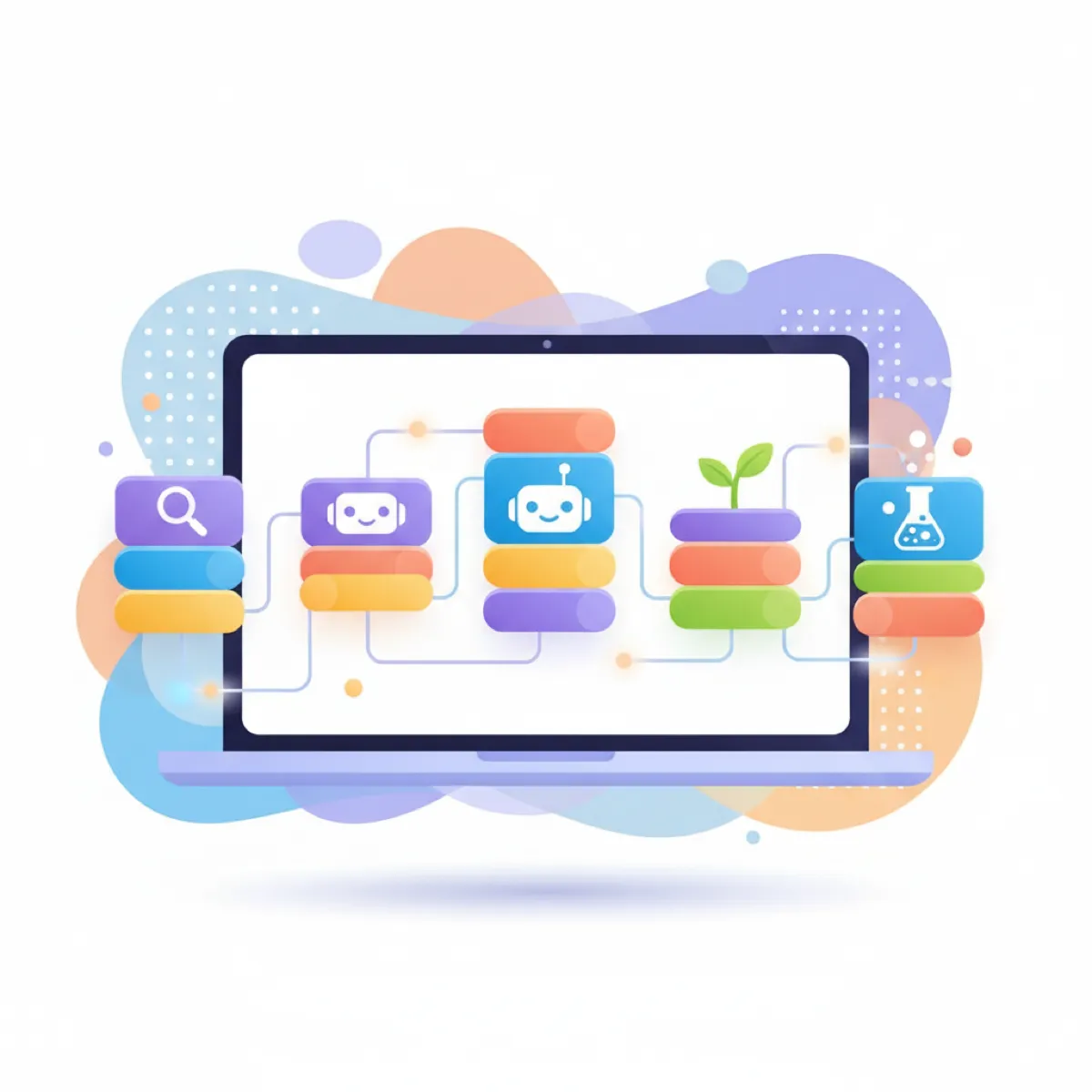
5 AI Science Experiments Kids Can Do at Home (No Coding Required)
Version 2.8 — Updated August 2026
You don't need to know Python to understand artificial intelligence. In fact, some of the most eye-opening AI experiences come from free tools that run right in your browser. These five experiments ar
Hands-On AI Learning Without a Single Line of Code
You don't need to know Python to understand artificial intelligence. In fact, some of the most eye-opening AI experiences come from free tools that run right in your browser. These five experiments are designed for kids (and curious adults) who want to see how AI actually works -- by doing, not just reading.
Each experiment takes 15-30 minutes, needs nothing but a computer with a webcam and internet, and includes a "what just happened" explanation so your child walks away actually understanding the AI concept behind the fun.
Experiment 1: Train AI to Recognize Hand Gestures
Tool: Google Teachable Machine (completely free, no account needed)
Materials: Computer with webcam
Steps:
- Go to Teachable Machine and click "Get Started," then choose "Image Project."
- Create three classes. Label them: "Thumbs Up," "Thumbs Down," and "Peace Sign."
- For each class, hold up the gesture and click "Record" to capture about 30 images. Move your hand slightly each time so the AI sees variations.
- Click "Train Model." Wait about 30 seconds.
- Test it! Hold up a gesture and see if the AI recognizes it correctly.
- Try tricking it -- hold up a fist, turn your hand sideways, or use your other hand.
What just happened: You just did the same thing Google engineers do when building AI. You gave the computer examples (training data), it found patterns in those examples, and now it makes predictions about new images. The more varied examples you give, the smarter it gets -- just like studying for a test with different practice problems.
Discussion questions: What happened when you tried to trick it? Why did more examples make it better? What other gestures could you train it to recognize?
Experiment 2: Discover How Neural Networks "See"
Tool: Quick, Draw! by Google (free, no account)
Materials: Computer or tablet
Steps:
- Open Quick, Draw! and click "Let's Draw!"
- You'll get a word -- like "cat" or "bicycle" -- and 20 seconds to draw it.
- Watch as the AI guesses in real-time what you're drawing.
- Play 6 rounds, then review your drawings.
- Click on any drawing to see what the AI thought it might be at each stage.
- Now look at the "dataset" -- see how millions of other people drew the same thing.
What just happened: The AI was trained on millions of doodles from players around the world. It learned that a "cat" usually has two triangle ears, whiskers, and a round head. It doesn't "understand" what a cat is -- it recognizes patterns of lines. This is exactly how image recognition works in self-driving cars and medical scanning, just with much more complex images.
Discussion questions: Did the AI recognize messy drawings? Why might it confuse a "clock" with a "pizza"? What does this tell us about how AI "thinks" versus how humans think?
Experiment 3: AI vs Human Drawing Challenge
Tool: Any AI image generator -- Playground AI gives 50 free images per day
Materials: Paper, pencils, computer
Steps:
- Choose a subject everyone will draw -- for example, "a dragon sitting on a library."
- Everyone (kids and parents) draws their version on paper. Set a 5-minute timer.
- Now type the exact same description into Playground AI and generate an image.
- Line up all the drawings and the AI image side by side.
- Vote on categories: Most Creative, Most Detailed, Funniest, Most Original.
- Notice what the AI gets "right" and what it gets weird (count the fingers!).
What just happened: AI generates images by predicting what pixels probably go together based on millions of images it trained on. That's why it's technically impressive but often misses things that make sense to us -- like how many fingers a hand has or how a library is actually organized. Your drawing has something the AI's doesn't: personal intention and meaning.
Discussion questions: Whose drawing tells the most interesting story? What mistakes did the AI make that a human wouldn't? Is the AI version "better" -- and what does "better" even mean in art?
Experiment 4: Train a Plant Identifier
Tool: Google Teachable Machine (free)
Materials: Computer with webcam, 3-5 different houseplants or leaves from outside
Steps:
- Open Teachable Machine, start a new Image Project.
- Create a class for each plant. Name them (or make up fun names like "Spiky Steve").
- Hold each plant in front of the webcam and record about 40 images per plant. Rotate it, show different angles, vary the distance.
- Train the model.
- Test with each plant. Then try holding up something that's NOT a plant -- like a shoe or a book.
- See what happens when you hold up a plant the AI hasn't seen before.
What just happened: You built a real image classifier -- the same type of AI that farmers use to detect crop diseases and biologists use to identify species in the wild. Your model learned specific visual features of each plant. When it saw something new, it tried to match it to the closest thing it knew -- which is why it might hilariously classify your shoe as a fern.
Discussion questions: How many images did it take before the AI got accurate? What happened with the unknown plant? How could you make this model useful in real life?
Experiment 5: Create an AI Song
Tool: Chrome Music Lab (free) + Suno (10 free songs per day)
Materials: Computer
Steps:
- Start with Chrome Music Lab's "Song Maker." Create a simple melody by clicking boxes on the grid. Play it back and adjust until you like it.
- Now open Suno. In the prompt, describe the kind of song you want: "A happy pop song about a cat who goes to space, with a fun chorus."
- Hit "Create" and wait about 30 seconds.
- Listen to what Suno creates. It'll have lyrics, melody, and instrumentation.
- Compare your Chrome Music Lab creation with Suno's output.
- Try giving Suno a very specific prompt, then a very vague one. Compare the results.
What just happened: Chrome Music Lab let you compose using basic rules of music theory -- patterns and repetition. Suno's AI was trained on massive amounts of music and learned patterns: what chord progressions sound "happy," what rhythms feel "bouncy," how verses and choruses typically work. It's making predictions about what sounds good together, not actually "feeling" the music.
Discussion questions: Which song did you like better -- yours or the AI's? What was missing from the AI's song? Could an AI write a song that makes you cry? Why or why not?
Keep the Learning Going
These experiments are starting points, not endpoints. Each one demonstrates a core AI concept: training data, pattern recognition, classification, and generation. Once your child grasps these basics, they'll understand the technology behind everything from Netflix recommendations to voice assistants -- and they'll approach AI with informed curiosity rather than blind trust or unnecessary fear.
What Success Looks Like (And What It Doesn't)
Parents often measure AI education success by the wrong metrics. Here's a recalibration:
Success IS:
- Your child asks "how does this work?" instead of just using AI passively
- Your child can explain an AI concept to a friend or sibling in their own words
- Your child spots an AI-generated image or text without being told
- Your child chooses to use AI for creating, not just consuming
- Your child questions AI outputs: "Is this actually true?"
Success IS NOT:
- Your child uses AI tools for X hours per week (time ≠ learning)
- Your child can list 20 AI tools by name (knowledge ≠ wisdom)
- Your child gets A's by using AI for homework (grades ≠ understanding)
- Your child impresses adults by using "AI vocabulary" (jargon ≠ comprehension)
The 3-Month Challenge
Want to put this article into action? Here's a structured 3-month plan:
Month 1: Explore
- Try 2-3 different AI tools from this article
- Spend 15-20 minutes per session, 3-4 times per week
- Focus: What does my child enjoy? What frustrates them?
- Goal: Identify 1-2 tools that genuinely engage your child
Month 2: Build
- Settle on 1-2 primary tools
- Complete at least one structured project or challenge
- Start connecting AI learning to school subjects
- Goal: Your child creates something they're proud of
Month 3: Reflect
- Discuss what they've learned about AI (not just what they've done with it)
- Evaluate: Has their critical thinking about technology improved?
- Decide: Continue with current tools, try new ones, or adjust approach
- Goal: AI literacy becomes a natural part of your child's thinking, not just screen time
Expert Perspective
AI education researchers consistently emphasize three principles:
Process over product — How a child interacts with AI matters more than what they produce. A child who asks thoughtful questions learns more than one who generates impressive outputs.
Transfer over mastery — The goal isn't mastering one AI tool. It's developing thinking patterns that transfer to any tool, any technology, any future challenge.
Agency over compliance — Children who choose to use AI thoughtfully are better prepared than those who follow AI rules without understanding why.
These principles should guide every decision about AI tools, screen time, and learning activities.
Continue learning with our 7-Day AI Camp. Explore AI tools by age group.
Ready to try this with your child?
Knowing which AI tool helps for homework is one thing — getting your child to actually use it productively is another. These five products are how we bridge that gap at home.
| Your child's goal | Try this | Why it works |
|---|---|---|
| Build 3D creations hands-on | 🧱 3D Block Adventure | Browser-based 3D building with 15 AI-guided levels. Ages 4-12, no downloads. |
| Play an AI game right now | 🎨 Wendy Guess My Drawing | A 60-second drawing game where the AI tries to guess. Ages 5-12, zero setup. |
| Learn AI over 7 structured days | 🏕️ 7-Day AI Camp | Day 1 is free. 15 minutes a day covering art, story, music, and safety. |
| Create art, stories, or music | 🎨 AI Creative Studio | Built-in safety filters. Three free creations a day without signing up. |
| Pick the right AI tool for your child | 🛠️ 55+ Kid-Safe AI Tools | Filter by age, subject, safety rating, and price. Every tool parent-tested. |
All five start free, run in the browser, and never ask for a credit card up front.
Explore More AI Learning Projects
Discover AI creative projects for kids, learn while playing
Browse Projects📋 Editorial Statement
Written by the KidsAiTools Editorial Team and reviewed by Felix. Our guides are written from a parent-builder perspective and focus on AI literacy, age fit, pricing transparency, and practical family use. We do not currently claim named external expert review or a child-test panel. We may earn commissions through referral links, which does not influence our reviews.
If you find any errors, please contact support@kidsaitools.com. We will verify and correct as soon as we can.
Last verified: August 28, 2026