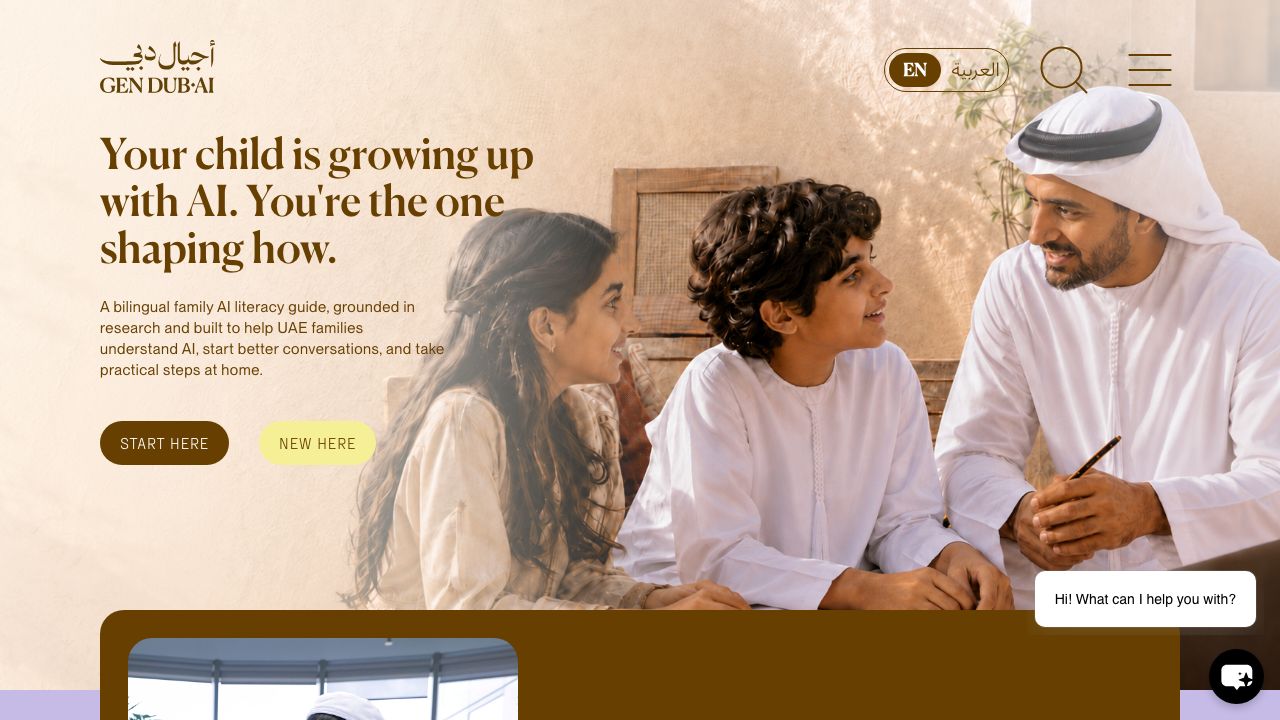
GenDubAI: A Family AI Literacy Guide for Parents
Version 2.10 — Updated October 2026
Use GenDubAI’s free family resources to discuss AI homework, choose a conversation card and agree on one practical next step with your child.
When your child shows you something made with AI, it can be difficult to know what to ask next. Generation DubAI gives parents a place to start with the situation in front of them: homework, creative projects, personal advice or a growing habit of asking AI first.
The resource was developed by the Dubai Centre for Artificial Intelligence and Dubai Future Foundation with the Community Development Authority. It is written for parents and caregivers of children aged 8–15 in the UAE, with English and Arabic versions. The public guidance is free to browse. Official introduction and FAQ
Choose the entrance that matches today
You do not have to read the whole website in order. Use one of its three entrances according to what you need.
| Your situation | Where to start |
|---|---|
| Something has happened and you need a response | Moments |
| You want a clearer explanation of an AI topic | Guides |
| You want to try a short activity together | Activities |
Choose one page before inviting your child into the conversation. A focused question is easier to respond to than a sudden lecture about everything AI might change.
Start with the homework situation
The homework Moment separates a finished assignment from understanding the work. It includes conversation guidance, background, age differences and something to try.
For your family, choose a small part of the assignment rather than asking your child to defend the whole evening's work. Invite them to explain how they reached one answer. Listen for where they made a decision, where they needed help and what still feels confusing.
If they get stuck, return to that step together. Being unable to explain something immediately can have several causes; it is a starting point for help, not a verdict about effort or honesty.
Before the next assignment, check the teacher's rules together and agree on what assistance is allowed. A boundary set before the task is easier to follow than one introduced after the work has been handed in.
Try one conversation card
Open the conversation cards, select the relevant age range and read a card together. Next moves to another card; Shuffle offers a different starting point. You can simply talk about the question without saving or submitting an answer.
Here is a practical way to use a card at home:
- Let your child answer first, without searching for the answer you think they should give.
- Offer your own response, including anything you are unsure about.
- Ask what information might change either person's view.
- Stop after one worthwhile exchange. Keep another card for a different day.
If the topic feels too abstract, connect it to an AI result your child has actually seen. Avoid turning every question into a test. The aim is to make the conversation possible again next time.
Adjust the conversation to your child
The platform separates guidance for ages 8–11 and 12–15. Use those choices to find a starting point, then adapt the language to your child.
With a younger child, stay close to a concrete action: a picture they chose, an answer they checked or a detail they decided not to share. With an older child, leave room to discuss school expectations, credit for their own work and situations where they would prefer a person's advice.
If you disagree, identify the decision you need to make together. You do not have to settle every question about AI before agreeing how to handle tomorrow's homework.
Language and practical details
GenDubAI's English and Arabic resources reflect the UAE context. Families elsewhere can use the conversation ideas while checking their own school rules and local support arrangements. Local emergency and reporting information on the website is intended for Dubai.
Browsing the guidance does not require a child to open a chatbot account. Optional newsletter and feedback forms are separate from reading or discussing the activities; check the terms before submitting information. A Chinese explanation of the resource does not turn the original activities into a Chinese-language product.
Keep the next step small
Choose one page, one conversation and one action to revisit. That might be asking your child to show how they checked an answer or agreeing when they will try a problem themselves first.
Our GenDubAI resource page collects the main entry points. For a conversation after a child has used a chatbot, see our parent conversation guide. Neither reading GenDubAI nor using this guide requires a KidsAiTools membership.
📋 Editorial Statement
Written by the KidsAiTools Editorial Team and reviewed by Felix. Our guides are written from a parent-builder perspective and focus on AI literacy, age fit, pricing transparency, and practical family use. We do not currently claim named external expert review or a child-test panel. We may earn commissions through referral links, which does not influence our reviews.
If you find any errors, please contact support@kidsaitools.com. We will verify and correct as soon as we can.
Last verified: October 29, 2026